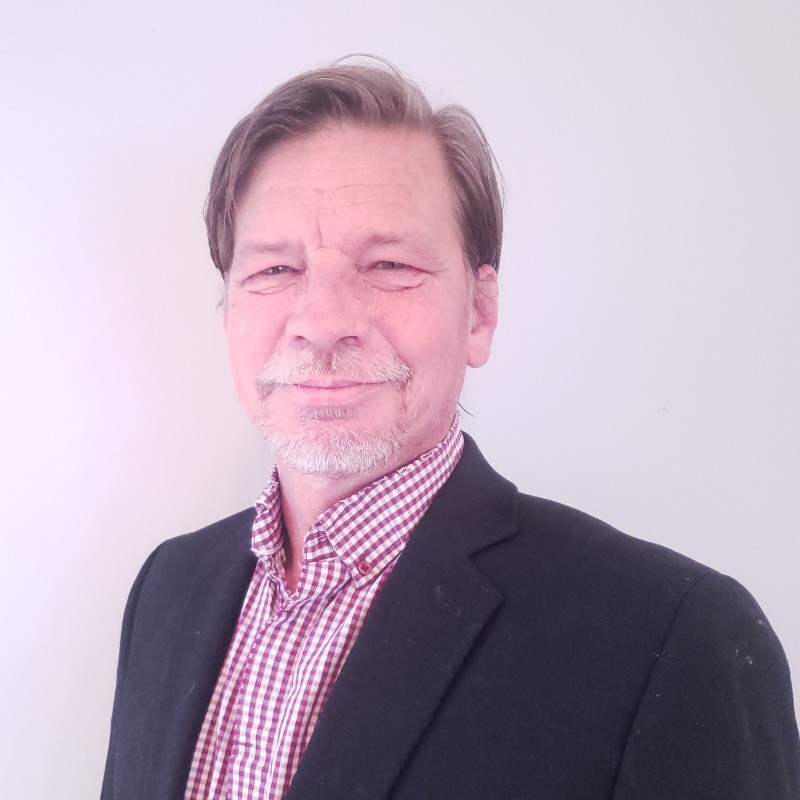
Founder, Neuralogic · Marietta, GA
20+ years building, delivering, and fixing technology programs across healthcare, financial services, manufacturing, aviation, and retail. The pattern that kept repeating was the same: the technology wasn’t the problem. The workflow it landed on was.
The arc
Chapter 1 · 1999–2005
Thomas started as a software engineer during the dot-com era in the Bay Area — building web applications, data systems, and background automation services from scratch. The work was technical and hands-on. It was also the period where the pattern first appeared.
The systems he built worked. But the workflows they were built on often didn’t — not because the code was wrong, but because the process the technology was supposed to accelerate had never been redesigned to match. The software automated a broken workflow instead of replacing it. The problem moved upstream; the code was just where you could see it.
Before joining WellSky, Thomas held senior engineering roles building production systems used at real scale: a web-based Point of Sale platform supporting more than 1,500 terminals and processing over $100 million in annual revenue at Wireless Retail Inc.; a pre-employment background check automation service that cut order completion time by 60% at PRSI/US Search; and component-architecture web applications at VISComm and Bio Online during the early Java era. The through-line was the same across all of it: gather requirements, design the system, build it, ship it, learn that the problem was upstream of the code.
Chapter 2 · WellSky — 2005–2013
Thomas joined WellSky in 2005 as Lead Software Engineer. He spent eight years there — writing production code in C# and .NET, designing HL7 integration pipelines with Cerner and Epic hospital information systems, and leading the technical architecture of a flagship inpatient medical application used by hospital systems across the country.
Around 2010, he started transitioning into the Technical Project Manager role while retaining technical authority over the platform. The shift was less a career pivot than a change in vantage point. From the PM seat, the pattern was impossible to ignore: integration projects failed not because the HL7 mapping was wrong, but because the clinical workflow the integration was supposed to serve had never been mapped. The technology was precise. The surrounding process wasn’t.
Thomas responded by introducing Lean and Kanban at WellSky — an organization running traditional waterfall delivery. He built the company’s first Kanban board, coached the engineering and QA teams on flow efficiency and WIP limits, and applied Value Stream Mapping to document current-state development workflows before redesigning them. The board remained in continuous use for more than three years. That was the proof of concept for the process-first idea: once the workflow was visible and redesigned, the technology work ran cleaner, faster, and with fewer surprises.
Flagship inpatient medical application — HL7 integrations with Cerner and Epic EMR platforms, covering clinical documentation, orders, billing, and ICD-9/10 compliance, aligned to HITECH Act EHR meaningful-use objectives.
Distributed teams of up to 35 members. Transitioned from waterfall to Lean/Kanban delivery. Led architectural reviews and code reviews through end of engagement in 2013 — even after moving to the PM role, remained the technical authority on the platform.
Chapter 3 · FPT Software — 2013–2023
In 2013 Thomas joined FPT Software, a global technology services firm, to run their US delivery practice. It was a single client engagement worth roughly $1 million. Ten years later, when he left to found Neuralogic, the portfolio had grown to $50 million across Fortune 500 accounts spanning healthcare, financial services, manufacturing, retail, aviation, and automotive — with global delivery teams in Vietnam, the Philippines, Costa Rica, and Belarus.
He reported weekly to FPT’s CEO on delivery health, customer satisfaction, P&L results, and staffing needs across the portfolio. He owned headcount, hiring, performance management, and the formal PMO governance structure he built from scratch for the US practice. At peak scale he was managing up to 17 concurrent client engagements and the largest single-account delivery team in the FPT portfolio — 135 people working across multiple time zones for Cox Automotive.
Throughout the decade, the methodology was consistent regardless of industry: map the actual current-state workflow using Value Stream Mapping before touching the technology. Apply the 5 Whys to understand why a process exists before redesigning it. Fix the handoffs and the single-person dependencies. Then, and only then, align the technology to the clean process. He became SAFe Release Train Engineer and Scrum Master certified during this period, ran PI Planning events across multi-team programs, and coached dozens of delivery teams through Agile transformation engagements — including clients who had been mandated to adopt Agile but had never done it before.
Embedded within Boeing’s Emerging Technology Center of Excellence — a deliberately startup-like environment inside a safety-critical enterprise. Shipped Boeing’s first public mobile application, Toolbox Mobile Library, to Google Play and the Apple App Store (React/React Native), used by airline mechanics performing maintenance checks between flight legs. Safety-of-life mandate: downtime or stale data was not an operational inconvenience; it had direct implications for aircraft airworthiness.
Researched ML approaches for predictive maintenance and aircraft component failure prediction. Managed CI/CD pipeline automation (Maven/Jenkins), UAT process, post-release hypercare, and tiered support models for field mechanics. Also delivered a number of Boeing programs using traditional Waterfall methodology within legacy departments where sequential milestone-driven delivery was the established standard — flexibility across methodologies, not attachment to one.
Led the largest single-account delivery team in the FPT portfolio — up to 135 members across onshore and global delivery locations — primarily within Manheim, Cox Automotive’s vehicle wholesale auction and fleet remarketing division. The work was post-merger systems integration: unifying the technology and customer experience across Cox Automotive’s numerous acquired brands (Manheim, Autotrader, Kelley Blue Book, Dealer.com, vAuto, NextGear Capital, and others) onto a consistent platform.
Designed and implemented PagerDuty on-call escalation policies across 17 delivery teams. Facilitated PI Planning as SAFe Release Train Engineer. Owned RACI matrices, RAID logs, and full program governance across the account.
Managed end-to-end delivery of a clinical blood imaging pipeline — digital image capture of blood samples, ML-based disease detection models, and transmission of diagnostic results to Laboratory Information Systems (LIS) via HL7. Imaging pipeline included DICOM-based image handling for digital hematology workflows.
Chapter 4 · Neuralogic — 2023–Present
Thomas founded Neuralogic in 2023 after 20 years of watching the same failure mode repeat across organizations of every size: the technology was implemented before the process was redesigned. The fix was always the same. Map the actual workflow. Fix the handoffs. Then the tool selection becomes obvious.
The original consulting work at Neuralogic was enterprise-scale — a 12-state Medicaid program, a global information security initiative at a major US bank, a GenAI chatbot built on Vertex AI for one of the country’s largest retailers. The client base has since reoriented toward something Thomas found more satisfying: small and mid-sized businesses in Cobb County and the Atlanta metro where the exact same process-first discipline produces results in days instead of quarters, and where the person you speak with on Tuesday is the same person doing the work on Wednesday.
Led multi-state Medicaid Electronic Visit Verification integration program across 12 states — designed and implemented SSIS-based ETL pipelines for eligibility, patient data, referrals, authorizations, claims, and payments processing. Integrated with HHAExchange, Coastal, Fiserv, Jiva, and FACETS, with FHIR-based data exchange for portions of the interoperability scope.
Conducted requirements-gathering sessions directly with individual state Medicaid offices to confirm eligibility rules and compliance criteria for each state. Managed post-go-live hypercare including defect triage, SLA tracking, and compliance exit criteria sign-off.
Embedded Delivery Manager for The Home Depot’s internal GenAI chatbot initiative — built on Vertex AI and Google Gemini with a Retrieval-Augmented Generation (RAG) architecture, grounding Gemini responses in Home Depot’s proprietary product and operational knowledge base via AlloyDB vector search on GCP.
Drove sprint cadence, backlog prioritization, release planning, and milestone tracking against a firm cutover date. Applied structured quality rubrics at each sprint gate. Coordinated release readiness and production deployment. Weekly executive status reporting from kickoff through software distribution.
Technical Delivery Manager for a year-long COTS software implementation program within Bank of America’s Global Information Security organization — coordinating three distinct workstreams: a third-party commercial software vendor managing installation and configuration, Cisco managing network equipment procurement and deployment, and internal BofA Infrastructure and Lines of Business teams handling server builds and decommissioning.
KPI-driven executive status reporting and risk mitigation throughout. New server builds, Cisco networking switch deployments, Ethernet and cellular infrastructure, and server decommissioning across the enterprise security footprint.
Led Azure database migration — lift-and-shift from bare metal servers to Azure, followed by SQL Server and Windows upgrades. Milestone-driven, fixed-bid Waterfall structure with clearly sequenced phases (assessment, migration, upgrade, validation).
Infrastructure modernization — Cisco networking switch deployments alongside labeling infrastructure upgrades across manufacturing facilities. Sequential, milestone-driven delivery with structured post-cutover hypercare.
How it works
Process → People → Technology. In that order. Always.
The tools that persist — Value Stream Mapping, the 5 Whys, RAID logs, RACI matrices, sprint retrospectives — are all tools for making the actual workflow visible before deciding what to change. The question is never “what should we buy?” It’s “where does the work actually wait, and why?” Once that’s visible, the path forward is usually obvious — and much cheaper than the technology purchase that was about to be authorized.
Twenty years across Boeing, Beckman Coulter, Cox Automotive, Bank of America, Home Depot, and AmeriHealth Caritas. Dozens of smaller businesses in between. The size of the organization doesn’t change the nature of the problem. The friction lives at the handoff. The root cause is upstream of where it hurts. And the fix almost never requires another tool.
Small businesses in Cobb County have one structural advantage that Fortune 500 organizations don’t: they can move. A process redesign that would take a large enterprise six months to work through twelve departments can be mapped in a morning, redesigned in an afternoon, and running differently within a week. That’s the reason Neuralogic exists.
Credentials
30 minutes. No prep needed. You walk away knowing where your biggest process friction is and what fixing it would actually take.
5 min: What’s stuck this week • 15 min: Walk the current path of that work • 5 min: What “fixed” looks like in 30–60 days • 5 min: Whether consulting, staffing, or neither is the right next step
Book the 30-minute call See the approach →